The painted hall
The Sala Terrena frescoes
What a sala terrena is, what the Teutonic Order says about the painted hall in Vienna, what the murals show and which questions the sources leave open.
Reserve a seat in the Sala Terrena ↗Quick answer
A sala terrena is a ground-floor garden hall, a feature of 17th- and 18th-century palaces. The one in the Teutonic Order's Vienna house is a domed central room whose walls carry illusionistic murals of ornament, figures and mythological scenes, which the Order dates to the late 18th century. It was once open to the courtyard and is normally opened for concerts and treasury tours.
What a sala terrena is
The name is Italian for a ground-level hall, and German-speaking countries also call it a Gartensaal, a garden hall. Palaces of the 17th and 18th centuries often placed one on the main axis, opening to the garden so that the building flowed out into it. Because it sits at ground level it is cool and was used mostly in summer. There is no fixed decoration for such a room: shell grottoes, stucco, marble and painting all occur. Vienna's version is one of the painted type, and its link to the courtyard is now closed.
What the Order says
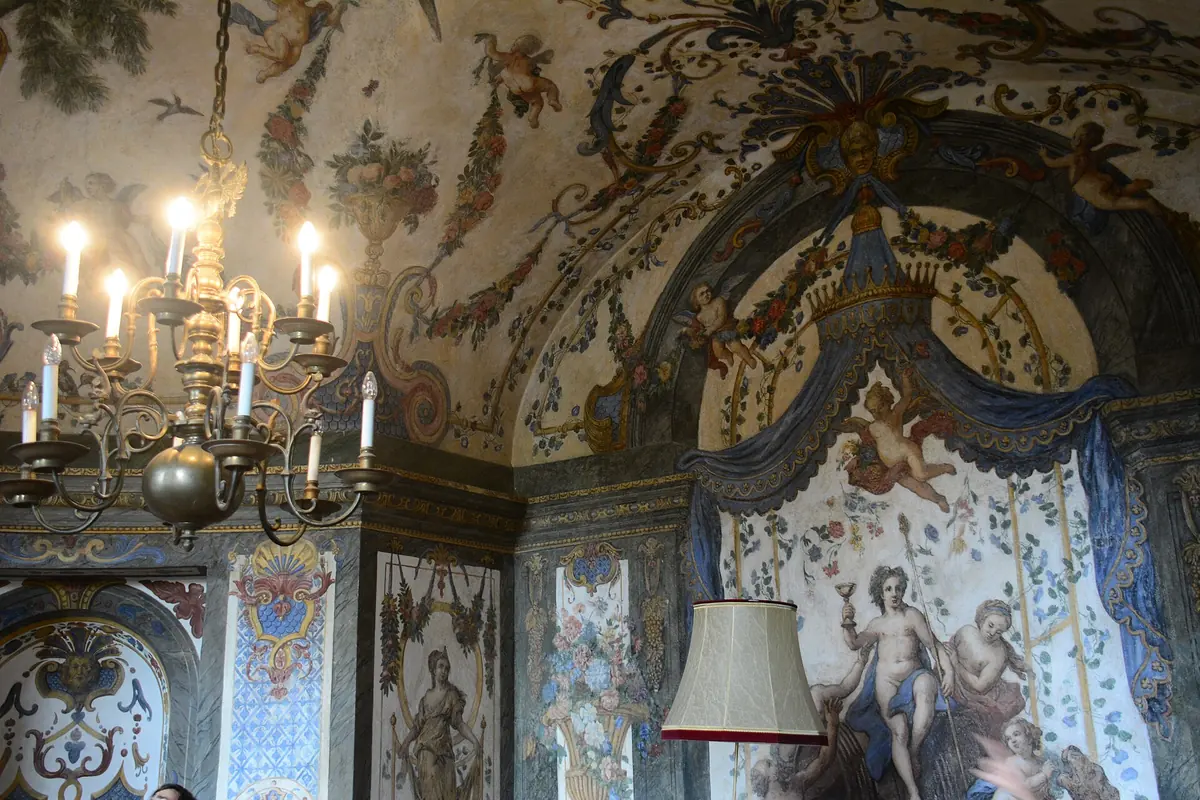
The Teutonic Order describes the Sala terrena as a central room, vaulted with a flat dome, on the ground floor next to the church. It says the walls carry illusionistic murals from the late 18th century showing ornament, figures and mythological scenes. It adds that the room once opened to the courtyard through a door that is now a closed window, that it is normally opened only for concerts, and that it can also be seen on guided tours of the treasury. The sources read for this guide do not name the painter, so the room is best described by what the Order says about it and by the photographs on this page.
What the murals show
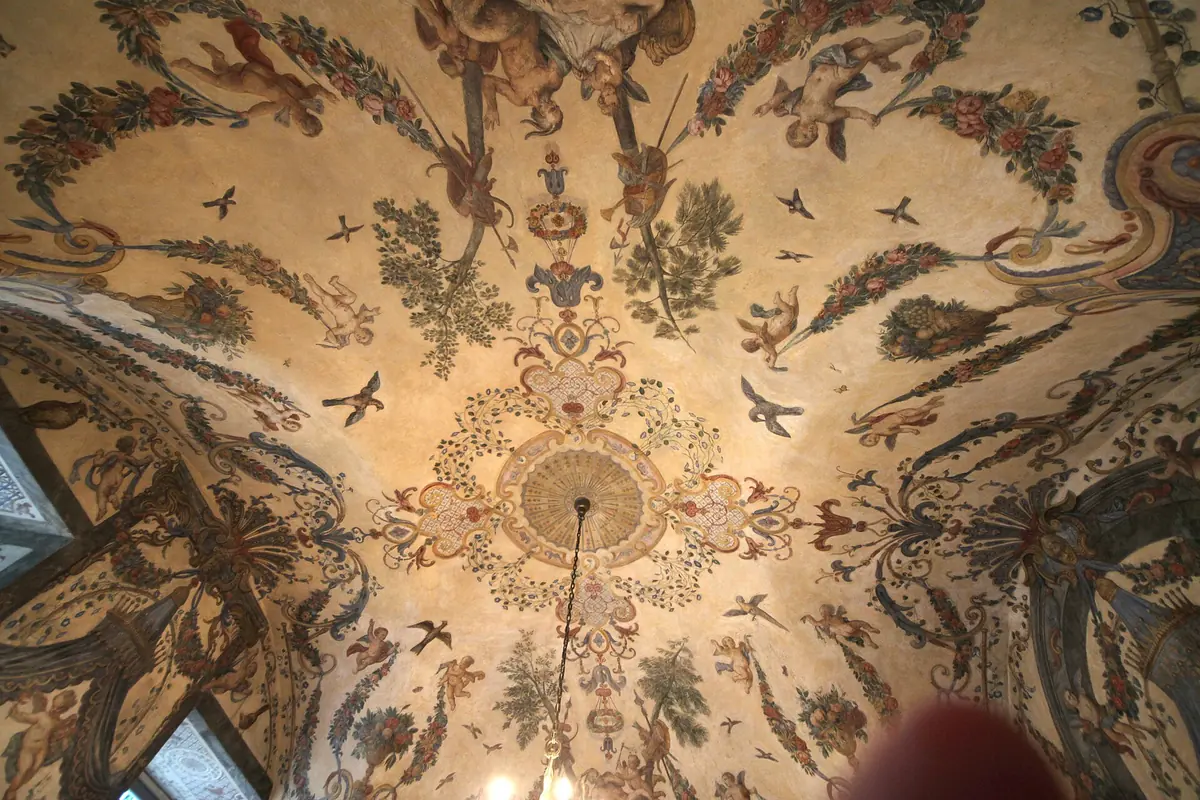
Photographs show a room painted as if it were hung with decoration. A painted blue canopy with gold trim frames a scene on the wall, and garlands of flowers run across the vault. Cherubs hold wreaths, birds cross the ceiling, and weapons and tools of art are painted as trophies. In one wall panel a seated woman holds a dish of fruit while a cherub carries a sheaf of wheat and grapes, and an elderly man reclines below. The Order calls the subjects mythological, and this guide does not name the figures, because the sources read do not.
Trompe l'oeil as a trick of the eye
The Order's word 'illusionistic' matters. The painters imitate things that are not there: draped cloth, framed panels, marble and carved ornament, so that a flat wall reads as a furnished room. In the photographs the blue canopy and its tassels look like real fabric, and the pilasters between the panels look like stone. That is the whole idea of the style: a room that looks dressed with hangings, frames and stone while the surface stays flat.
Why it matters for the concert
The room is the reason to choose this concert over a plainer hall. The organiser describes baroque frescoes and an intimate acoustic, and the vaulted shape suits a small ensemble. Listeners sit close to the musicians, and the painted dome closes over the group. The Order's page says the room opens for concerts, so a concert ticket is the usual way in. A second way is a guided tour of the treasury, which the Order says can include a view of the room, though the tour details are for the Order to give. Either way, the room is seen as part of a working religious house, and visitors should expect to follow the house's own rules.
Read next: Sala Terrena concert: practical
Frequently asked questions
How old are the murals?
The Teutonic Order dates them to the late 18th century.
Who painted them?
The sources read for this guide do not name the painter.
Can I see the room without a concert?
The Order says it can be seen on guided tours of its treasury. Ask the Order about tour times, since they are separate from the concert.
What is a sala terrena?
A ground-floor hall, usually at the garden side of a palace, typical of the 17th and 18th centuries.
Sources