The building
Teutonic Order house, Vienna
The Teutonic Order's house on Singerstraße: its history, the Gothic church, the treasury and archive, its lodgers and how to see more than the hall.
Reserve a seat in the Sala Terrena ↗Quick answer
The Deutschordenshaus at Singerstraße 7 is the Teutonic Order's house in Vienna. The Order dates its Vienna branch to about 1204/06, and the house has been the seat of its Grand Master since 1809. It holds a Gothic church, a treasury, a central archive and a guest house, and the Sala Terrena concerts take place in its painted hall.
The Order and its Vienna house
The Teutonic Order grew from a fraternity founded around 1190 in Acre and took over a hospital there in 1191. Today it is a Catholic religious order, purely religious since 1810. Its Vienna branch on Singerstraße was founded about 1204/06 and became its main seat in Austria. The order is one of few church institutions whose head does not live in Rome. German Wikipedia says the house received its present form in 1667, which is why much of the exterior reads as 17th- and 18th-century.
The church
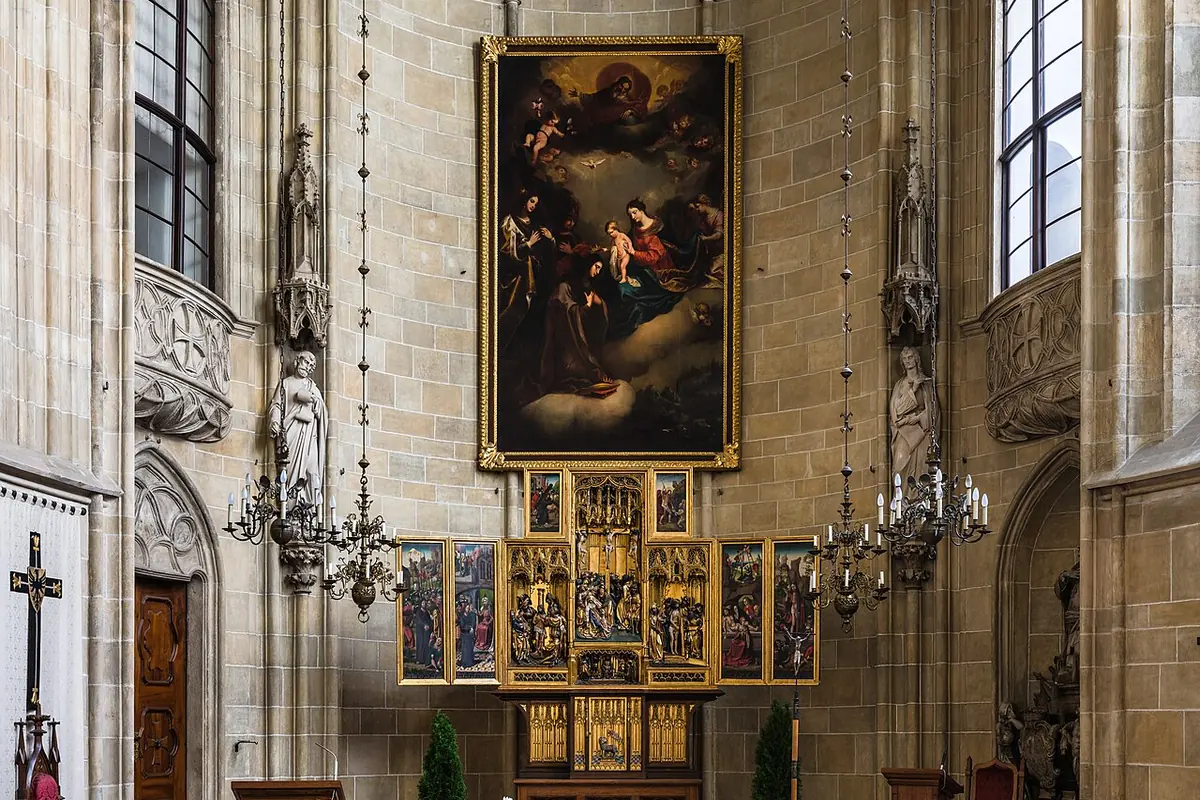
The Deutschordenskirche, dedicated to St Elisabeth, is a Gothic church built between 1326 and 1375, according to German Wikipedia, and it forms one building complex with the house. It is the church whose gate the booking page tells concertgoers to use. The Order's page says service times are listed on its church section, so check there before a visit. A church that has been worshipped in for centuries behaves differently from a museum: dress sensibly and keep voices low if you step inside before the concert.
The treasury and the archive
The Order's house holds the General Command, the church, the treasury, the central archive and a guest house. The Schatzkammer, the treasury, shows the Order's insignia and is open to the public, with its own visitor information and its own hours on the Order's site. The Order adds that the Sala Terrena can be visited as part of guided tours of the treasury. The historic central archive is also housed here, though it is not a visitor attraction. Hours and tickets are the Order's to state, so this guide gives none.
A house for the Grand Master
Since 1809 the building has also been the seat of the Order's Grand Master, the Hochmeister. German Wikipedia adds that the Hochmeister were, for centuries, Archdukes of Austria, which shows how closely the Order was tied to the Habsburg court. Parts of the building are now used by church offices and education bodies, and there is a guest house. In other words the Deutschordenshaus is a working institution, which is why the concert hall is not a stand-alone venue.
Mozart and Brahms
Two composers are linked to the house. Mozart lodged here in 1781 in the household of Archbishop Colloredo, and a plaque inside the entrance marks it. Johannes Brahms lived on the top floor from 1863 to 1865, according to German Wikipedia and the Order's page. A concert programme that includes Brahms is not promised, but the connection is a reminder of how long music and lodging have gone together in this building.
Read next: Mozart in the Deutschordenshaus
Combining it with the concert
Come a little early to see the courtyard, which a visitor guide describes as quiet, with a tower of St Stephen's above its walls. Singerstraße is in the Inner City, so the cathedral and the shops of Stephansplatz are close. Check the Order's church and treasury hours before you plan a daytime visit, since they differ from the concert's. If you only have one evening, the concert is the way to see the Sala Terrena itself, and the museum on Domgasse is a separate visit.
Frequently asked questions
What is the Deutschordenshaus?
The Teutonic Order's house in Vienna at Singerstraße 7, with a church, a treasury, a central archive and a guest house.
Who lived there?
Mozart lodged there in 1781 and Brahms lived on the top floor from 1863 to 1865.
Can I visit the treasury?
Yes. The Schatzkammer is open to the public with its own visitor information, and the Order's site gives hours.
Is it the same as the Mozarthaus museum?
No. The museum is on Domgasse. The Deutschordenshaus is on Singerstraße and holds the Sala Terrena concerts.
Sources